
Symbolism, Identity, and Consciousness in Contemporary African Art
Introduction
Portraiture has long occupied a central place within the history of art. Traditionally associated with representation, status, memory, and identity, the portrait has evolved significantly within contemporary African artistic practice. Today, many African artists approach portraiture not simply as depiction, but as conceptual language.
The modern African portrait increasingly functions as:
- social commentary
- psychological inquiry
- symbolic architecture
- cultural resistance
- philosophical reflection
Within contemporary African art, the human figure often becomes more than an individual subject. It becomes metaphor—a site where conversations surrounding inheritance, value, identity, memory, land, consciousness, and transformation converge.
This shift marks an important evolution in how portraiture is understood. The African figure is no longer presented merely for observation. It is positioned as a carrier of meaning.
Moving Beyond Representation
Historically, portraiture often reinforced systems of power and visibility. Kings, aristocrats, political leaders, and wealthy patrons commissioned portraits as records of influence and status.
Contemporary African artists, however, increasingly disrupt this tradition by using portraiture to interrogate rather than simply celebrate.
The portrait becomes layered with symbolism:
- minerals
- florals
- textiles
- ornamentation
- topographical references
- abstract forms
These elements extend the figure beyond likeness into philosophy.
The subject is no longer simply a person.
The subject becomes an idea.
This conceptual approach allows portraiture to operate simultaneously across emotional, political, historical, and spiritual dimensions.
The African Figure as Symbol
One of the most powerful developments within contemporary African portraiture is the repositioning of the African body itself.
For centuries, African figures were frequently represented externally through colonial, anthropological, or reductive frameworks. Contemporary African artists now reclaim the authority to define their own visual narratives.
In many works, the African figure appears:
- dignified
- monumental
- contemplative
- adorned
- spiritually charged
The body becomes symbolic territory.
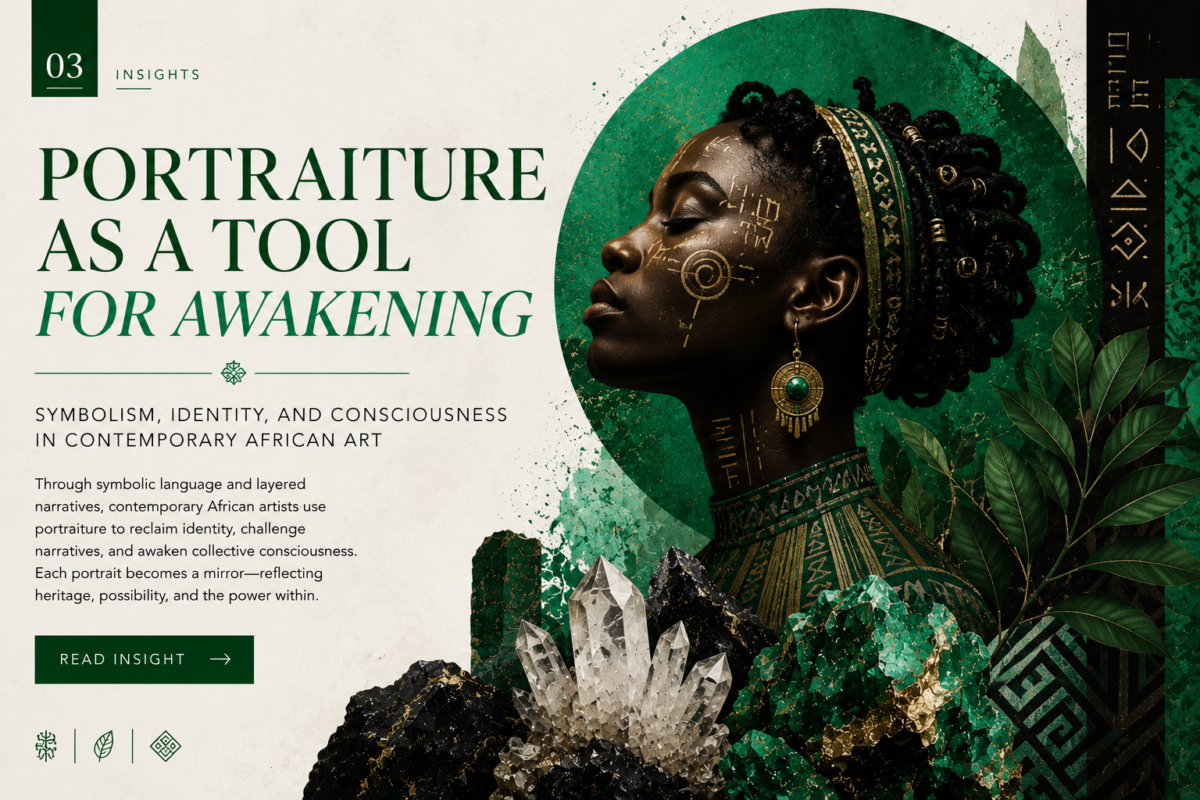
Expressions, posture, gaze, and material elements all contribute to the construction of meaning. Silence within a portrait can communicate resistance. Ornamentation may symbolize inherited wealth. Geological textures may suggest ancestral connection to land.
Through these visual systems, portraiture becomes an instrument of psychological and cultural reconstruction.
Symbolism and Layered Meaning
Symbolism remains one of the defining features of contemporary African portraiture.
Rather than offering direct explanation, symbolic visual language invites interpretation and contemplation. This creates richer engagement between artwork and viewer.
Minerals may represent hidden prosperity.
Florals may symbolize regeneration and possibility.
Textiles may reference heritage and continuity.
Gold may communicate both value and burden.
These symbolic systems transform portraiture into an active intellectual experience rather than passive viewing.
The viewer is invited not simply to observe the painting, but to enter dialogue with it.
Portraiture and Consciousness
Many contemporary African artists use portraiture as a framework for awakening consciousness.
This involves challenging inherited narratives surrounding:
- scarcity
- inferiority
- dependency
- identity
- ownership
- value
Portraiture becomes a psychological intervention.
By constructing powerful, symbolically rich African figures, artists create alternative visual realities capable of reshaping how audiences perceive Africa and themselves.
The goal is not merely admiration, but recognition.
Recognition of:
- dignity
- possibility
- inherited wealth
- agency
- collective responsibility
This makes portraiture deeply relevant within societies navigating questions of transformation and self-definition.
The Role of Scale and Presence
Scale plays an important role within contemporary African portraiture.
Large-scale paintings create physical presence. They demand attention. They refuse invisibility.
Monumental portraiture often communicates:
- importance
- authority
- permanence
- psychological impact
When combined with symbolic systems, large-scale works become immersive environments rather than simple images.
The viewer does not merely look at the artwork.
The viewer encounters it.
This encounter becomes emotionally and intellectually significant.
Contemporary African Art and Global Dialogue
African contemporary portraiture now occupies major global art spaces:
- biennales
- museums
- galleries
- fairs
- institutional collections
Artists such as Kehinde Wiley, Kerry James Marshall, and Yinka Shonibare have contributed significantly to expanding conversations around Black representation, identity, and visual power.
A newer generation of African artists continues this evolution by integrating philosophical inquiry, symbolism, and socio-economic discourse into portraiture.
This global visibility matters because representation shapes cultural memory. Art influences how societies imagine themselves and how they are imagined by others.
Portraiture therefore becomes more than aesthetics.
It becomes narrative power.
Conclusion
Contemporary African portraiture is undergoing a profound transformation. No longer confined to likeness or documentation, it has evolved into a symbolic and philosophical language capable of addressing some of the continent’s most urgent conversations.
Through layered visual systems involving portraiture, minerals, textiles, florals, and symbolic abstraction, artists are constructing works that interrogate value, identity, consciousness, inheritance, and transformation.
The African figure emerges not as passive subject, but as active carrier of meaning, memory, and possibility.
In this context, portraiture becomes more than image-making.
It becomes awakening.