
Reimagining Africa’s Mineral Wealth Through Contemporary Art
Introduction
Africa possesses some of the world’s richest mineral reserves. Gold, cobalt, lithium, diamonds, crude oil, copper, uranium, and rare earth materials continue to shape global industries and geopolitical interests. Yet despite this immense abundance, many African nations remain trapped within cycles of underdevelopment, extraction dependency, and unequal value distribution.
This contradiction raises important questions:
How can a continent so rich remain economically fragile?
Why has abundance not consistently translated into transformation?
What does ownership truly mean in resource-rich societies?
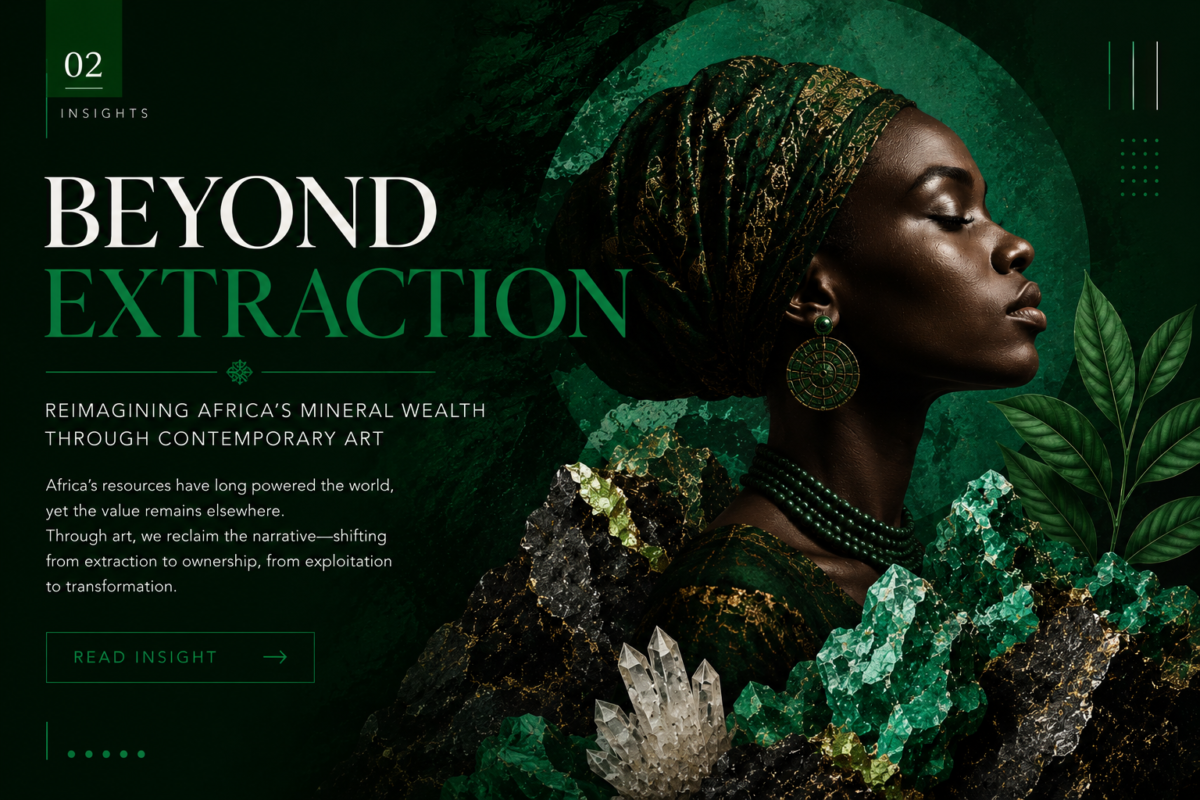
Contemporary African art increasingly engages these questions not through statistics or policy analysis, but through symbolic visual language. Artists are constructing powerful narratives around land, inheritance, extraction, value, and consciousness—using portraiture and symbolism to challenge dominant perceptions surrounding Africa’s wealth.
Within this framework, mineral wealth becomes more than geology. It becomes metaphor.
Extraction Without Transformation
For centuries, Africa’s relationship with its resources has largely been defined by extraction. Colonial economies were built upon the removal of value from African land for foreign development and industrialization. In many ways, contemporary systems still mirror these structures.
Raw materials continue to leave the continent while value creation often happens elsewhere.
This has produced a dangerous imbalance:
Africa remains globally essential while frequently remaining locally underdeveloped.
Contemporary artists are increasingly responding to this imbalance by interrogating the symbolic meaning of resources themselves. Minerals within paintings no longer function merely as decorative references. They become carriers of political, economic, and philosophical inquiry.
Gold may symbolize prosperity and exploitation simultaneously.
Oil may represent both opportunity and environmental vulnerability.
Gemstones may suggest hidden value obscured by systems of extraction.
Through symbolic layering, artists reveal the tension between abundance and deprivation.
Mineral Symbolism in Contemporary African Art
One of the defining characteristics of contemporary African visual language is the increasing use of symbolism as conceptual architecture.
Rather than presenting literal political commentary, artists frequently construct layered compositions where minerals, florals, geological textures, textiles, and portraiture interact metaphorically.
This symbolic approach allows artworks to operate on multiple levels simultaneously:
- aesthetic
- philosophical
- historical
- economic
- spiritual
In many works, the African figure becomes intertwined with the land itself. Minerals appear embedded within garments, skin, environments, or ornamental systems—suggesting inseparable relationships between people and territory.
The implication is profound:
Africa’s wealth is not external to its people; it exists in direct relationship with them.
This reframing shifts the conversation away from passive resource ownership toward active stewardship and consciousness.
Ownership and Consciousness
One of the most important conversations surrounding mineral wealth is not simply access, but awareness.
Ownership without consciousness often leads to dependency.
Abundance without structure often leads to instability.
Many contemporary African artists explore this tension visually. Their works suggest that inherited wealth alone is insufficient. Transformation requires recognition, responsibility, and intentional development.
Portraiture within these works frequently communicates psychological states:
- introspection
- awakening
- contemplation
- burden
- authority
The figure becomes symbolic of societies standing at the intersection of inheritance and decision-making.
What happens when a people fully recognize their value?
What structures emerge when consciousness changes?
What futures become possible when inherited wealth is no longer ignored?
These questions increasingly define contemporary African artistic discourse.
Art as Economic and Cultural Resistance
Art possesses the ability to challenge systems beyond politics.
Through exhibitions, biennales, institutional collections, and international visibility, contemporary African artists are reclaiming narrative authority over how Africa is represented globally.
Historically, African wealth has often been discussed externally:
through economics,
through extraction,
through geopolitics.
Today, African artists are reclaiming that narrative internally through culture.
This shift matters deeply because culture shapes perception, and perception shapes policy, investment, and identity.
By visually reframing African resources as symbols of agency rather than exploitation alone, artists contribute to broader cultural transformation. They invite audiences to see wealth not merely as material possession, but as collective responsibility.
The Relationship Between Land and Identity
Across many African societies, land carries meaning beyond economics. It embodies ancestry, spirituality, memory, belonging, and continuity.
Contemporary artists increasingly reflect this layered relationship within their visual practices. Geological textures, topographic references, earthy palettes, and mineral symbolism become extensions of identity itself.
The land is not neutral.
It remembers.
It carries history.
It shapes consciousness.
By connecting portraiture with geological symbolism, artists emphasize the inseparability between people and place. This creates visual narratives that challenge detached, purely extractive understandings of African wealth.
The conversation shifts from:
“What can be taken?”
to
“What must be protected, cultivated, and transformed?”
Conclusion
Africa’s mineral wealth remains one of the most powerful and contested realities shaping the continent’s future. Yet contemporary African art suggests that the deeper challenge may not simply be extraction, but consciousness.
Through symbolic portraiture and layered visual narratives, artists are reimagining mineral wealth as more than economic capital. They position it as cultural inheritance, philosophical inquiry, and collective responsibility.
In doing so, contemporary African art contributes to a broader redefinition of value itself—one that moves beyond exploitation toward stewardship, awareness, identity, and transformation.
The future of Africa’s wealth may ultimately depend not only on what lies beneath its land, but on how its people choose to see, understand, and activate it.