
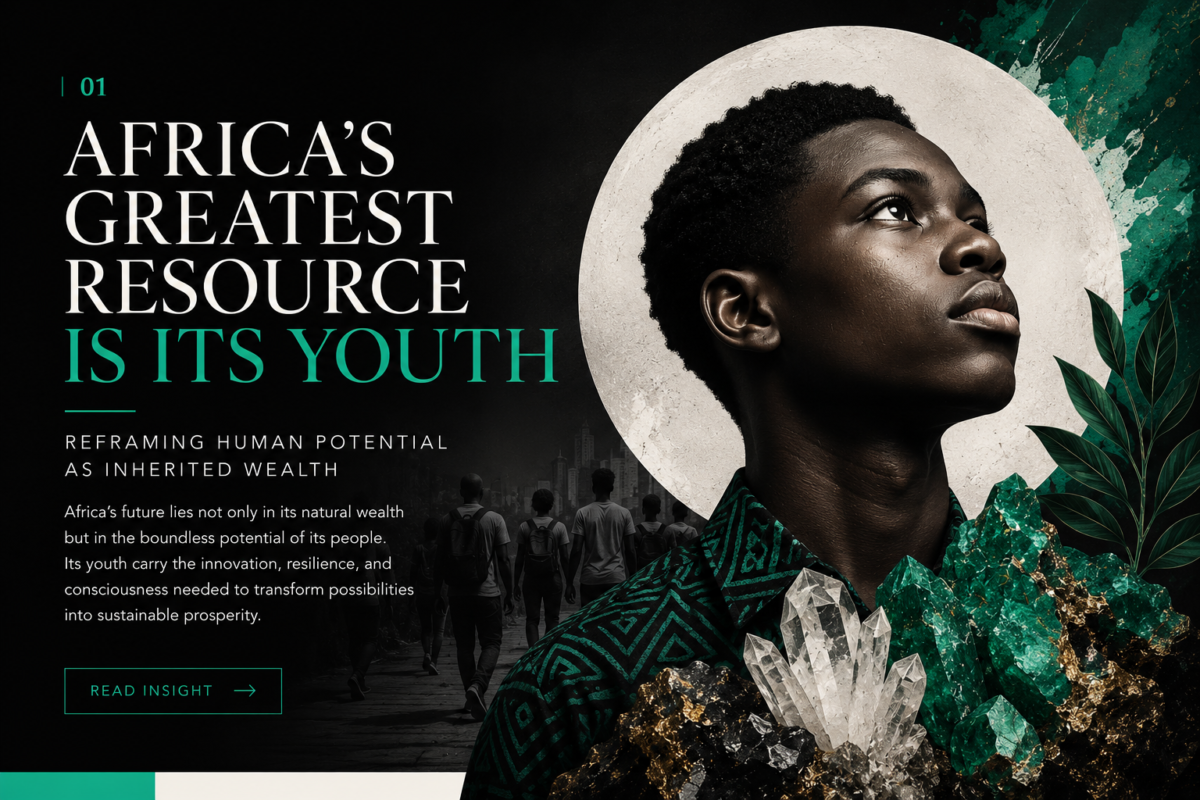
Reframing Human Potential as Inherited Wealth
Introduction
For decades, conversations surrounding Africa’s wealth have largely centered on its minerals, oil reserves, agriculture, and extractive industries. While these resources undeniably contribute to the continent’s global significance, one of Africa’s most valuable assets remains consistently underdeveloped, underestimated, and frequently overlooked its youth.
Across the continent exists an extraordinary concentration of creativity, resilience, intelligence, adaptability, and untapped innovation. Yet, despite this abundance, millions of young Africans continue to navigate systems constrained by limited access, weak institutional structures, economic instability, and inherited narratives of scarcity. The tragedy is not the absence of potential, but the under-activation of it.
Within contemporary African art, this conversation has become increasingly urgent. Artists are no longer simply producing aesthetic objects; they are constructing visual and philosophical frameworks capable of interrogating identity, value, consciousness, and inherited responsibility. Through symbolic portraiture and conceptual storytelling, a growing generation of artists is reframing African youth not as victims of limitation, but as carriers of dormant wealth.
Beyond Demographics: Youth as Capital
Africa possesses the youngest population in the world. Yet demographic advantage alone does not automatically translate into transformation. Human potential becomes meaningful only when systems of recognition, cultivation, and intentional development exist.
This is where the conversation must shift.
African youth should not merely be viewed as a labor force or statistical advantage, but as a form of inherited capital. Just as mineral deposits hold value beneath the earth, human capacity holds value beneath conditions of neglect, underinvestment, and unrealized possibility.
In many contemporary African paintings, portraiture increasingly functions beyond representation. The human figure becomes symbolic—standing as a site of tension between possibility and suppression, inheritance and abandonment, consciousness and underutilization.
The visual language emerging from contemporary African studios reflects this urgency. Materials, textures, geological references, florals, textiles, and symbolic compositions are now being used to position the African figure as both bearer and steward of future prosperity.
Art as a Framework for Awakening
Art has historically played a critical role in shaping consciousness. Across generations, visual culture has functioned as documentation, resistance, protest, spirituality, and social commentary. Today, contemporary African artists are extending that responsibility further by using visual language as a tool for awakening.
The modern African portrait is no longer merely about likeness. It is increasingly about value.
Through symbolism and layered narrative systems, artists are questioning:
- Who owns wealth?
- What defines prosperity?
- Why do abundance and underdevelopment coexist?
- What responsibilities accompany inherited potential?
These questions carry deep relevance within African societies where wealth often exists alongside structural fragility. The role of art, therefore, becomes both reflective and provocative.
By positioning African youth within symbolic environments tied to minerals, florals, land, and ornamentation, artists challenge audiences to reconsider the continent’s greatest resource—not simply what lies beneath the soil, but what exists within its people.
The Psychological Legacy of Scarcity
One of the most damaging inheritances of colonial disruption and postcolonial instability is not merely economic limitation, but psychological conditioning. Generations have inherited systems that normalize underestimation, dependency, and externally validated worth.
This creates a dangerous contradiction:
A continent rich in resources continues to perceive itself through narratives of insufficiency.
Contemporary African art increasingly confronts this contradiction by constructing alternative visual narratives. Through scale, symbolism, posture, materiality, and composition, artists are rebuilding images of dignity, agency, and possibility.
Portraiture becomes more than image-making. It becomes psychological reconstruction.
The African figure is repositioned not as marginal, but central.
Not lacking, but endowed.
Not waiting for value, but carrying it inherently.
Creativity as Economic Infrastructure
Another important shift occurring within African contemporary art is the recognition of creativity itself as infrastructure.
Historically, industries such as technology, finance, oil, and manufacturing have dominated conversations around economic transformation. Yet the global creative economy increasingly demonstrates that culture possesses enormous economic power.
African artists today are participating in international biennales, global gallery systems, institutional collections, auctions, residencies, and cultural markets at unprecedented levels. This signals more than artistic success—it reflects the growing global relevance of African intellectual and cultural production.
Art contributes to:
- cultural diplomacy
- economic ecosystems
- tourism
- identity formation
- historical preservation
- international visibility
Most importantly, it contributes to imagination.
And imagination is often the first stage of transformation.
The Responsibility of Recognition
Potential alone changes nothing.
Recognition must be followed by cultivation, structure, and responsibility. This is perhaps where the conversation becomes most urgent. Inherited wealth—whether human or natural—requires stewardship.
The challenge facing African societies is not merely discovering value, but developing systems capable of protecting and maximizing it.
This responsibility belongs to:
- governments
- institutions
- educators
- artists
- entrepreneurs
- cultural leaders
- communities
The contemporary African artist occupies a unique position within this landscape. Through visual language, artists possess the ability to influence perception long before policy changes occur.
And perception matters.
How societies imagine themselves often determines what they eventually become.
Conclusion
Africa’s greatest resource may not be hidden beneath the ground, but walking within its cities, communities, studios, universities, and streets every day.
Its youth represent more than demographic possibility; they represent inherited wealth waiting for recognition, cultivation, and activation.
Contemporary African art continues to play a critical role in this awakening. Through symbolic portraiture and conceptual visual narratives, artists are reframing conversations around value, prosperity, identity, and consciousness—challenging viewers to see Africa not as a continent of limitation, but as one of profound and unrealized abundance.
The future of Africa may ultimately depend on whether its people learn to recognize the wealth they already carry within themselves.